Overview of Wuhu
Wuhu, anciently known as "Jiuzi", boasts a documented history spanning over 2,500 years. In ancient times, Wuhu benefited from the convergence of two rivers, the Yangtze River and the Qingyi River, facilitating water transportation, and thus flourished in agriculture, handicrafts, and commerce. In modern times, Wuhu was not only the birthplace of industry and commerce in the middle and lower reaches of the Yangtze River, but also one of the four great rice markets in China, with its port opened for trade in 1876. Wuhu administers five districts — Jinghu, Jiujiang, Yijiang, Wanzhi, and Fanchang — as well as Nanling County, and has a county-level city of Wuwei. Besides, there are two national-level development zones, one free-trade pilot zone, one national-level comprehensive bonded zone, and seven provincial-level development zones within its area, with a total area of 6,009 square kilometers and a permanent resident population of 3.797 million.
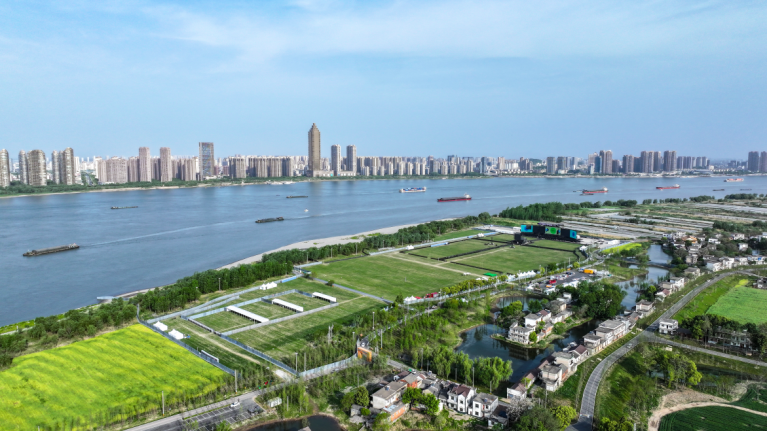
In contemporary times, Wuhu is one of the 27 core cities in the Yangtze River Delta that advances its development relying on the Yangtze River. As a sub-central city of Anhui Province, the province's second-largest economy, and a major city designated in the national development plan for the Yangtze River Delta urban agglomeration, an important member of the Hefei Metropolitan Circle, Nanjing Metropolitan Circle and the G60 Science and Technology Innovation Corridor, Wuhu is pooling the whole city's efforts to embark on a new chapter of building itself into an "Innovation City, Automobile City, Smart Computing City, Hub City, Happy City and Prosperous City". In 2024, its regional GDP exceeded the 500-billion-yuan mark. The city was selected into the 2025 China Top 100 Cities List and ranked among the 40 most successful cities over the past 40 years of China's reform and opening-up.
Wuhu is a booming industrial renowned city. Covering 37 out of the 41 major industrial categories in China, it is home to 3 enterprises with an annual output value exceeding 100 billion yuan – namely Chery Holding Group Co., Ltd., Anhui CONCH Group Co., Ltd. and Midea Group Co., Ltd. as well as 20 enterprises with over 10 billion yuan in annual output value. Among them, Chery Holding Group Co., Ltd. and Anhui Conch Group Co., Ltd. have been included in the Fortune Global 500 list. It has established economic and trade ties with 181 countries and regions, and 43 enterprises on Fortune Global 500 list from overseas have invested here. Besides, Wuhu has built an innovation matrix driven by four core sectors: new energy vehicles, robotics, low-altitude economy, and the digital economy under East-west computing resource transfer project. Moreover, it has been approved as a provincial-level pilot zone for three future industries, including low-altitude economy, humanoid robotics and hydrogen energy. Ranking 25th among Chinese cities in high-quality manufacturing development and 34th in the top 100 advanced manufacturing cities nationwide, Wuhu demonstrates strong momentum for industrial upgrading and future competitiveness by virtue of its solid industrial foundation and agglomeration of leading enterprises.
Wuhu serves as an important transportation hub in the Yangtze River Delta region. With its strategic location by the river and sea, as well as comprehensive water, land, and air transportation facilities, Wuhu is a national comprehensive transportation hub, a port-based national logistics hub, and a strategic fulcrum for modern circulation. The city boasts a 100-million-ton port, the Wuhu Port, as well as harmonious connections through the Beijing-Fuzhou High-Speed Railway, Nanjing-Anqing High-Speed Railway, Shangqiu-Hefei-Hangzhou High-Speed Railway, three Yangtze River bridges, Wuhu Xuanzhou Airport, rail transit, and river-crossing tunnels, forming an integrated multi-modal transportation system that ensures a smooth traffic flow. The approval of the temporary opening of the Wuhu Xuanzhou Airport as a port has established it as the only specialized air cargo hub airport in the plan for the world-class airport cluster in the Yangtze River Delta region. What's more, Wuhu has completed the construction and operation of the first large shipping market in the Yangtze River basin in China and is building the Wuhu river-sea intermodal hub to high standards. It has jointly established a service center with Shanghai Port and launched the "Wuhu-Yangshan" Yangtze River shared-cabin alliance route.
Wuhu is a highland of scientific and technological innovation with a sound environment. As one of the first national intellectual property demonstration cities and a national innovation-driven development demonstration city, Wuhu adheres to the principle of "industry + sci-tech innovation", and makes the construction of the Jiuzi Sci-tech Innovation Bay as a flagship initiative. It has built 18 innovation parks in the city's prime locations blessed with beautiful landscapes and cultural heritage, fostering a favorable ecosystem where the relevant enterprises spanning the upstream and downstream of the industrial chain are clustered in the same building or adjacent industrial parks, industrial parks are equivalent to industrial chains, and work circles are integrated with living circles. What's more, the city has developed major R&D platforms such as the Chery Kaiyang Laboratory, Qizhi Intelligent Robotics Laboratory and CCID (Wuhu) Sci-tech Innovation Center, gathering 50 national-level innovation platforms of various types, and has risen to the 22nd place among national innovative cities. Now, Wuhu is striving to build an innovation ecosystem integrating industrial chains, innovation chains and living circles, with its urban innovation capacity significantly enhanced.
Wuhu is a friendly city both for living and working. Known as a city as if "half covered by mountains and half by water," it embraces the integration of Yangtze River culture, open culture and Huizhou culture, thus nurturing a unique urban character of innovation, perseverance, openness, and inclusiveness. The city boasts beautiful scenery with mountains, rivers, lakes, and more than 180 ancient buildings and ruins, such as the Fanchang Kiln Site and Guangji Temple. Among them, Wuhu Ancient City is the most well-preserved ancient city on the south bank of the Yangtze River. Endowed with abundant educational and medical resources, Wuhu is home to 1031 primary and secondary schools and kindergartens of various levels, among which Wuhu No.1 High School and the High School Affiliated to Anhui Normal University are both century-old prestigious schools. There are 200,000 students enrolled in 12 universities and colleges, such as Anhui Polytechnic University and Wannan Medical University. Moreover, Wuhu has seven Grade-A Tertiary hospitals and has established two regional medical centers at national level in cooperation with Beijing Tiantan Hospital, Capital Medical University and Beijing Anding Hospital. Now, there are a total of 57 Bookrooms (Shufang) and 122 "pocket" parks throughout the city. Tourist attractions such as the Fantawild Tourist Area, Jiuzi Ancient Town, Sculpture Park, Wuhu Ancient City, and Squirrel Town are deeply loved by the public. Thanks to the sound environment, Wuhu has been selected as a national demonstration city for systematic and comprehensive sponge city construction, a national demonstration city for the reform and high-quality development of public hospitals, and a national pilot city for a 15-minute convenient lifestyle circle. Also, the city has won honorary titles such as National Civilized City, National Forest City, and Water Ecological Civilization City, and has received the China Habitat Environment Award five times.